
Physics A Level | Chapter 5: Work, energy and power 5.2 Gravitational potential energy
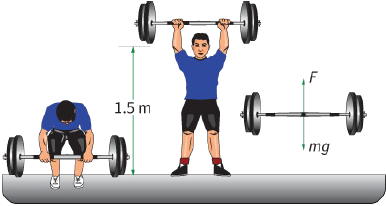
If you lift a heavy object, you do work. You are providing an upwards force to overcome the downwards force of gravity on the object. The force moves the object upwards, so the force is doing work.
In this way, energy is transferred from you to the object. You lose energy, and the object gains energy. We say that the gravitational potential energy, ${E_p}$ of the object has increased.
Worked example 2 shows how to calculate a change in gravitational potential energy (g.p.e.).
An equation for gravitational potential energy
The change ($\Delta $) in the gravitational potential energy (g.p.e.) of an object, Ep, depends on the change in its height, h. We can calculate ${E_p}$ using this equation:
$\begin{array}{l}
change\,in\,g.p.e\, = \,weigth\, \times \,change\,in\,height\\
\Delta {E_p}\, = \,(m \times g)\, \times \,\Delta h\\
\Delta {E_p}\, = \,mg\Delta h
\end{array}$
It should be clear where this equation comes from. The force needed to lift an object is equal to its weight mg, where m is the mass of the object and g is the acceleration of free fall or the gravitational field strength on the Earth’s surface. The work done by this force is given by force $ \times $ distance moved, or weight $ \times $ change in height. You might feel that it takes a force greater than the weight of the object being raised to lift it upwards, but this is not so. Provided the force is equal to the weight, the object will move upwards at a steady speed.
Note that h stands for the vertical height through which the object moves. Note also that we can only use the equation $\Delta {E_p} = mg\Delta h$ for relatively small changes in height. It would not work, for example, in the case of a satellite orbiting the Earth. Satellites orbit at a height of at least $200 km$ and g has a smaller value at this height.
Other forms of potential energy
Potential energy is the energy an object has because of its position or shape. So, for example, an object’s gravitational potential energy changes when it moves through a gravitational field. (There is much more about gravitational fields in Chapter 17.)
We can identify other forms of potential energy. An electrically charged object has electric potential energy when it is placed in an electric field (see Chapter 21). An object may have elastic potential energy when it is stretched, squashed or twisted–if it is released it goes back to its original shape (see Chapter 7).
Questions
6) Calculate how much gravitational potential energy is gained if you climb a flight of stairs. Assume that you have a mass of $52 kg$ and that the height you lift yourself is $2.5 m$.
7) A climber of mass $100 kg$ (including the equipment she is carrying) ascends from sea level to the top of a mountain $5500 m$ high. Calculate the change in her gravitational potential energy.
8) a: A toy car works by means of a stretched rubber band. What form of potential energy does the car store when the band is stretched?
b: A bar magnet is lying with its north pole next to the south pole of another bar magnet. A student pulls them apart. Why do we say that the magnets’ potential energy has increased? Where has this energy come from?